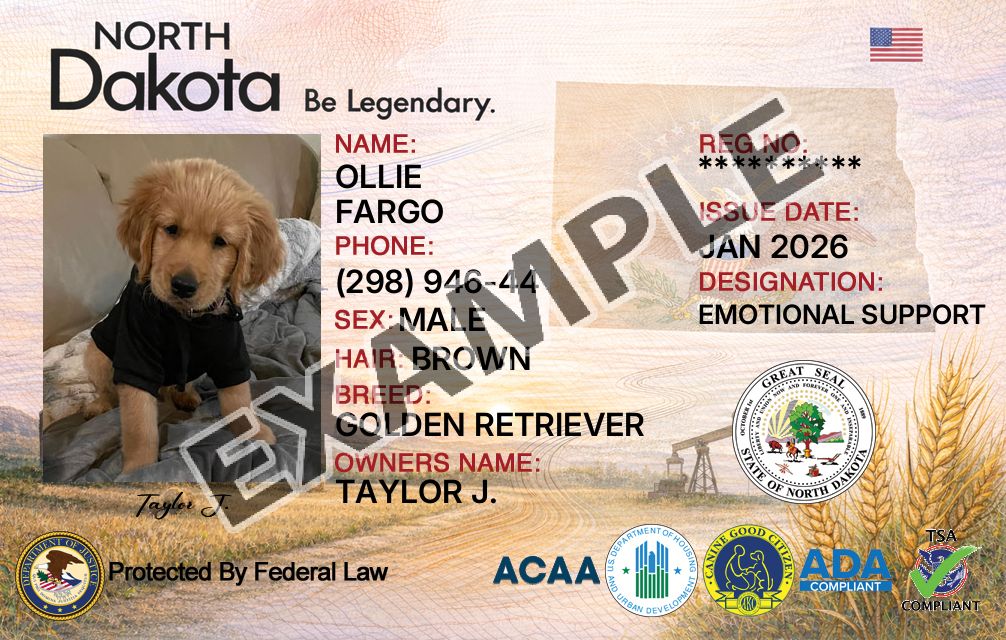
Registering a Dog in Kidder County, North Dakota (Service Dog or Emotional Support Dog)
If you’re asking where do I register my dog in Kidder County, North Dakota for my service dog or emotional support dog, the key thing to know is that “registration” usually means a local dog license (when required) and compliance with rabies vaccination rules—not buying an online certificate. In North Dakota, dog licensing is commonly handled locally (city-by-city), and enforcement often involves local law enforcement or animal control functions. This page explains how to find the right office, how a dog license in Kidder County, North Dakota typically works, and how licensing differs from service dog legal status and emotional support animal rules.
- A dog license is a local registration/permit (often annual) that may require proof of rabies vaccination.
- A service dog is defined by training and disability-related tasks under law—not by a license card, vest, or online registry.
- An emotional support animal (ESA) is not a service dog and does not have the same public-access rights.
Where to Register or License Your Dog in Kidder County, North Dakota
Because licensing is often handled at the city level (and because rural areas may rely on the sheriff’s office for certain animal control or rabies enforcement functions), start with the offices below. If you live inside city limits (for example, in Steele or Tappen), your where to register a dog in Kidder County, North Dakota answer is often the city office. If you live outside city limits, ask the county/sheriff office what applies where you live.
Kidder County Sheriff’s Office
Steele, ND 58482-0318
Note: Office hours and a public email were not available from official sources used for this page.
Kidder County Courthouse (General Building Contact)
Steele, ND 58482
Note: This is a general courthouse contact listing and may not be the licensing issuer itself.
Kidder County Auditor (County Contact)
Steele, ND 58482-0167
Note: Office hours and a street address were not available from the official directory entry used here.
City of Steele (City Office Contact)
Steele, ND 58482
Note: Street address and office hours were not listed on the official contact page used for this entry.
South Country Human Service Zone (Kidder County Office)
Steele, ND 58482
Steele, ND 58482
Note: No licensing authority is claimed here—this is included as a local official office for direction and referrals.
Overview of Dog Licensing in Kidder County, North Dakota
What “registering your dog” usually means
In many North Dakota communities, “registering” a dog means obtaining a local license (often annual) that helps connect a dog to its owner and supports local animal control and public health efforts. However, a single countywide system may not exist in every area. In practice, you may encounter:
- City-issued licenses (common) for residents within city limits
- County or sheriff involvement for complaints, stray dogs, and rabies enforcement—especially outside city limits
- Rabies-related procedures that involve public health guidance and local law enforcement when bites or exposures occur
Rabies vaccination is the foundation
Even when a community’s licensing rules vary, rabies prevention is consistent: proof of a current rabies vaccination is commonly required to license a dog locally. North Dakota’s animal health authorities also require dogs (and cats/ferrets) over 12 weeks old entering the state for any length of time to be vaccinated against rabies in accordance with the vaccine specifications, and to have documentation available.
Why service dogs and ESAs still matter here
People often search for an animal control dog license Kidder County, North Dakota because they want to “register” a service dog or an emotional support dog. A local license can still be required for any dog (service dog included) depending on local ordinance—but the license does not create service dog status, and an ESA letter does not turn a pet into a service animal.
How Dog Licensing Works Locally in Kidder County, North Dakota
Step 1: Determine whether you live inside city limits
The most important first step is figuring out whether your address is within a city (such as Steele or Tappen) or in an unincorporated area of Kidder County. Licensing rules can differ based on that boundary. If you are inside city limits, licensing is often handled by the city office (sometimes the city auditor/clerk). If you are outside city limits, ask the sheriff’s office or courthouse for the correct contact.
Step 2: Ask the right office what they require for a local dog license
When you call an official office, ask these exact questions to quickly get to a yes/no answer:
- Do you require a dog license in Kidder County, North Dakota where I live (city limits vs. rural address)?
- What documents do I need (rabies certificate, ID, proof of residency)?
- How often is renewal required (annual vs. multi-year)?
- Are fees different if the dog is spayed/neutered (if your ordinance uses that structure)?
- Do service dogs have any local licensing fee exemptions (if any), and what proof is acceptable?
Step 3: Keep rabies documentation accessible
Many local licensing processes are built around rabies vaccination proof. Keep a copy of your rabies certificate with: (1) the vaccination date, (2) the expiration date, and (3) the veterinarian’s information. If your dog ever bites someone, public health guidance can involve observation or quarantine procedures; keeping records current can simplify follow-up.
What if you can’t find a “county animal control” office?
Kidder County is rural, and some rural counties do not operate a stand-alone animal control department like larger metro areas. In those cases, animal-related enforcement and rabies follow-up may involve local law enforcement (often the sheriff) and public health guidance. If you’re unsure, start with the Sheriff’s Office and ask who handles stray dogs, nuisance complaints, and rabies-related enforcement in your area.
Service Dog Laws in Kidder County, North Dakota
A service dog is defined by training and tasks, not by registration
A service dog is generally a dog that is individually trained to do work or perform tasks for a person with a disability. That training-and-task requirement is what matters legally in most everyday contexts (public access). A city or county dog license, tag, vest, or online “registry” does not create legal service dog status.
Can a service dog still need a local license?
Yes. A service dog can still be subject to local licensing and rabies rules if the ordinance applies to “all dogs” kept in the city or community. Some places may offer fee waivers or exceptions, but those vary by local ordinance. The safest approach is: license the dog if your local office says licensing is required, and keep rabies documentation current.
What businesses can ask (and what they can’t)
Public-facing businesses typically cannot require you to show an “ID card” or proof of training. If you’re trying to avoid conflict, it helps to keep basic veterinary records (especially rabies proof) accessible for practical reasons—but remember that veterinary records are not the same as “service dog registration.”
Emotional Support Animal Rules in Kidder County, North Dakota
An ESA is not a service dog
An emotional support animal (ESA) provides comfort by its presence, but it is not trained to perform specific disability-related tasks in the way a service dog is. That difference affects where the animal can go and what legal protections apply.
Licensing and rabies rules still apply
If your community requires dog licensing, an ESA is still a dog under those rules—meaning the same local licensing steps and rabies documentation requirements typically apply. If you are searching “where do i register my dog in Kidder County, North Dakota for my service dog or emotional support dog,” the practical answer is: start with the local office that issues dog licenses (usually your city), then confirm county-level enforcement questions with the sheriff if needed.
Avoid third-party “ESA registration” websites
Many people are sold the idea that an ESA needs to be “registered” online. For local compliance purposes, what usually matters is (1) local licensing if required and (2) rabies vaccination proof. If you need ESA-related documentation for housing or another specific purpose, focus on legitimate documentation appropriate for that setting—not a generic online registry.